
Dubai Tightens Social Media Rules for Doctors, Healthcare Facilities and Influencers: What UAE Residents Need to Know
Published by InsurancePolicy.ae | September 2026
Social media has become an important source of healthcare information for people across the UAE. From Instagram and TikTok videos to YouTube content and WhatsApp campaigns, residents can now discover doctors, clinics, treatments and healthcare services with just a few clicks.
However, with the growing influence of social media in healthcare decisions, ensuring that online medical information is accurate, ethical and trustworthy has become increasingly important.
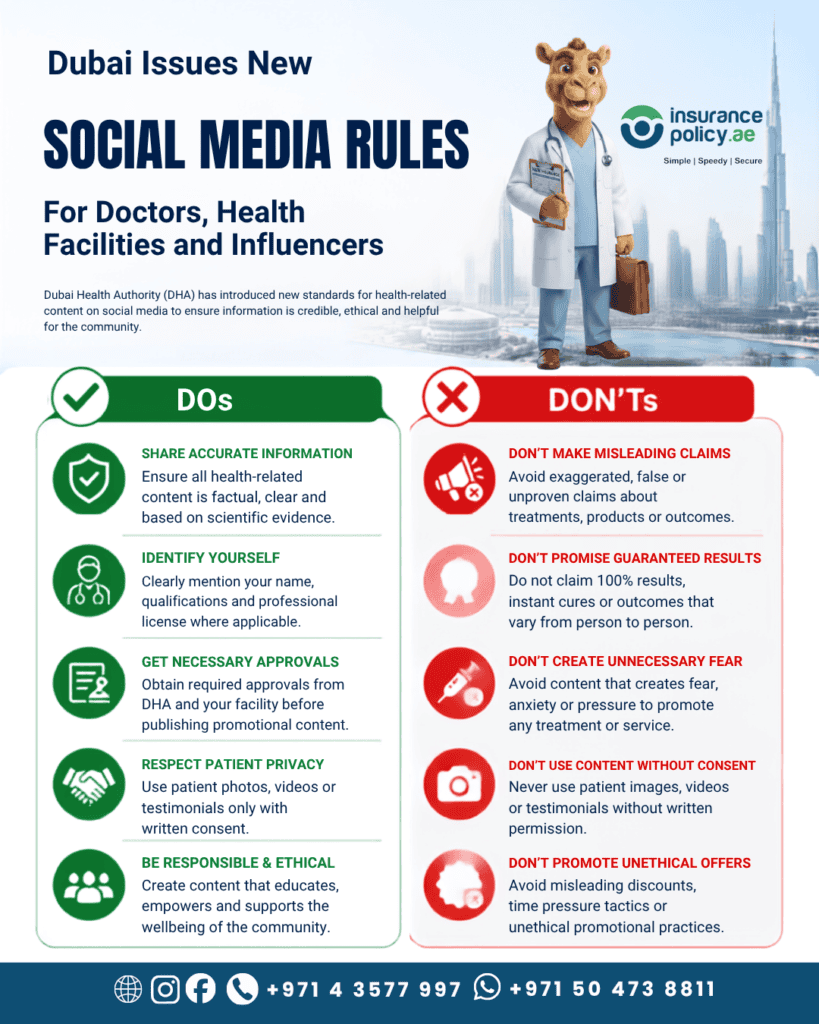
The Dubai Health Authority (DHA) has now issued updated standards for medical advertising content on social media, aimed at strengthening the credibility of healthcare information and protecting patients and the public from misleading or unethical advertising. The latest circular, CIR-2026-00000144, was issued on August 17, 2026, and applies to DHA-licensed health facilities and healthcare professionals in Dubai’s private healthcare sector.
What Are Dubai’s New Social Media Rules?
The new standards govern how healthcare services, treatments, professionals and facilities are promoted on social media.
According to the DHA, healthcare advertising published online should provide reliable information and help patients make informed decisions. The standards are designed to promote ethical advertising and prevent misleading, ambiguous or deceptive medical claims.
The rules cover social media platforms including Instagram, Facebook, TikTok, YouTube, Snapchat, WhatsApp and LinkedIn, according to the latest reporting on the DHA standards.
Misleading Medical Claims Are Not Allowed
One of the most important aspects of the standards is the restriction on exaggerated or absolute claims.
Healthcare advertisements cannot use claims or phrases that may create unrealistic expectations about a treatment, service or outcome.
Examples of prohibited claims reported under the standards include phrases such as:
-
“The best”
-
“100 per cent”
-
“Miraculous”
-
“Magic”
-
“Safest”
-
“Assured success”
-
“No side effects”
-
“Immediate results”
-
“Absolutely certain”
-
“Unprecedented”
The rules also prohibit negative or unfounded statements directed at other doctors, healthcare facilities or government entities.
For patients, this is an important development because healthcare decisions should be based on reliable medical information rather than exaggerated promises or promotional language.
Doctors Must Use Appropriate Professional Titles
The new standards also place restrictions on how healthcare professionals identify themselves in advertising.
Doctors and healthcare professionals must not use professional titles that differ from the titles reflected on their DHA licence.
The standards also specify restrictions around the use of the prefix “Dr.” and require appropriate professional qualifications where applicable.
This can help patients better understand the qualifications and professional status of the person providing healthcare information online.
Influencers and Healthcare Promotions
Social media influencers can play a major role in shaping consumer decisions. The DHA standards therefore also have implications when influencers promote healthcare facilities, treatments or outcomes.
Where social media content identifies or promotes a healthcare facility, appropriate approval requirements apply. The facility’s medical director has responsibility for relevant advertising content and compliance.
This means healthcare promotions cannot simply be treated like ordinary lifestyle or product advertising.
Patient Photos and Testimonials Require Consent
Patient privacy is another major part of the standards.
Written consent is required before a patient’s photo, video or statement is used in medical advertising. Separate parental consent is required when the patient is under 18.
The rules also place specific requirements on before-and-after images. Such photographs must represent the same person, be taken using the same lens and must not be digitally edited. A disclaimer stating that results may vary between individuals is also required.
These requirements are intended to ensure that patients are not given unrealistic expectations about possible treatment results.
Certain Medical Content Is Off-Limits
The standards also restrict promotional content that could manipulate or pressure patients.
Healthcare advertisements should not:
-
Create unrealistic expectations
-
Use fear or scare tactics to encourage treatment
-
Exploit a patient’s lack of medical knowledge
-
Make claims that one healthcare professional or facility is superior to another
-
Use inappropriate comparisons between healthcare professions
-
Promote content that conflicts with UAE laws, culture and values
The DHA also prohibits promotional filming or livestreaming inside operating theatres or procedure rooms while patients are undergoing surgery or are under general anaesthesia.
Healthcare Facilities Have Greater Responsibility
The responsibility does not end with the person who creates or uploads a social media post.
According to the reported standards, healthcare facilities must ensure appropriate oversight of their social media activity. Medical directors are responsible for ensuring staff understand the requirements, and facilities must maintain records of social media content for potential DHA monitoring and audits.
The DHA has also stated that failure to comply with the standards may result in appropriate disciplinary action.
Why Do These Rules Matter to UAE Residents?
For patients, these regulations are about more than social media marketing.
A short video or promotional post can influence someone’s decision to visit a clinic, undergo a treatment or spend a significant amount of money on healthcare.
By encouraging healthcare providers to use accurate information and avoid exaggerated claims, the standards can help create a more trustworthy online healthcare environment.
However, consumers should still do their own research and consult qualified healthcare professionals before making important medical decisions.
What Does This Mean for Health Insurance?
The new DHA standards also highlight a broader lesson for consumers: always look beyond the advertisement.
The same principle applies when choosing health insurance in the UAE.
A health insurance advertisement may highlight attractive benefits or a competitive price, but the actual value of a policy depends on its terms and conditions.
Before choosing a health insurance plan, consumers should consider factors such as:
-
Hospital and clinic network
-
Coverage limits
-
Inpatient and outpatient benefits
-
Emergency coverage
-
Maternity benefits, where applicable
-
Pre-existing condition terms
-
Deductibles and co-payments
-
Waiting periods
-
Exclusions
-
Pre-authorisation requirements
Understanding these details can help individuals and families choose coverage that better matches their healthcare needs.
The Importance of Making Informed Healthcare Decisions
Dubai’s updated social media standards send a clear message: healthcare communication must be responsible, transparent and trustworthy.
For doctors, healthcare facilities and influencers, this means taking greater care with every healthcare-related post, video, testimonial and advertisement.
For patients and consumers, it is a reminder not to rely solely on social media when making important healthcare decisions.
Whether you are choosing a doctor, considering a treatment or comparing health insurance plans, reliable information matters.
At InsurancePolicy.ae, we believe that informed decisions lead to better protection.
If you are looking for health insurance in the UAE, compare your options carefully and understand what your policy actually covers before making a decision.
Stay informed. Stay protected. Choose wisely.
Disclaimer
This article is for general informational purposes only and does not constitute medical, legal or insurance advice. Healthcare advertising requirements are subject to applicable Dubai Health Authority rules and regulations. Health insurance coverage is subject to the specific terms, conditions, exclusions, limitations and eligibility requirements of the applicable policy.
Source: Dubai Health Authority, Circular CIR-2026-00000144, Standards for Medical Advertisement Content on Social Media.